
Panorama of Emergency Medicine

PoEM is an international peer-reviewed (double-blind) independent open access journal dedicated to advancing knowledge and practice in emergency medicine.

ISSN : 3006-0966

Skip to main navigation menu Skip to main content Skip to site footer

Pediatrics & Neonates

1 Items

All Items

  • Ethical and Educational Perspectives on Involving Children and Adolescents as Simulated Patients in Pediatric Emergency Training

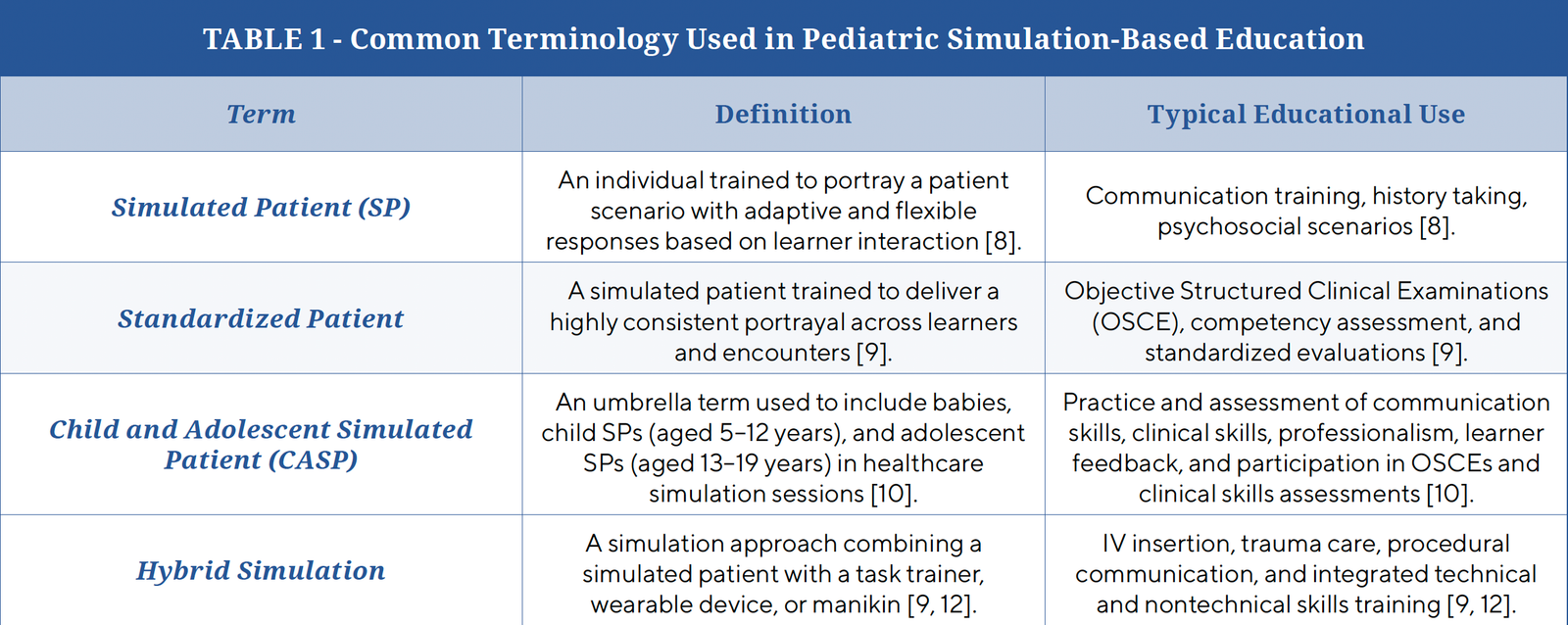
    Simulation in healthcare education encompasses a broad range of approaches, from tabletop exercises to the use of sophisticated computer-controlled manikins that mimic the physical appearance and physiological parameters of human beings. The use of simulated or standardized patients (SPs) in healthcare education is not new; however, it has evolved significantly over the past decade, particularly following the publication of the Association of Standardized Patient Educators' Standards in 2017. These standards complement a regularly updated series of best practice standards published by the International Nursing Association for Clinical Simulation and Learning, which aim to provide evidence-based guidelines to improve simulation delivery methods, ensure high-quality learner experiences, and promote the adoption of up-to-date operational procedures. Despite increasing adoption, there remains limited consolidated guidance specific to pediatric emergency contexts, which this paper aims to address.

    An area related to the use of SPs that remains controversial is the involvement of minors in an educational context. This narrative review synthesizes current literature and guidelines to examine the use of child and adolescent simulated patients (CASPs) in pediatric emergency medicine education, as well as their benefits and potential risks. It is recognized that the repetitive portrayal of certain medical conditions may have negative psychological or physical effects on children, and therefore, their involvement as SPs must be carefully considered. Specific measures should be implemented to protect young SPs and to prevent any adverse impact related to the roles they portray or the interactions they have with learners.

    The use of CASPs requires structured governance frameworks, age-appropriate role design, and formal safeguarding mechanisms to ensure ethical and effective integration. These recommendations extend beyond pediatric emergency medicine to other simulation-based educational contexts.

Latest articles

Indexing Information

PoEM News

Partnership

Journal Metrics

Meet the Board

Support for Authors

1

Getting Started

Register with journal and receive Author role. Access dashboard to begin new submission.
2

Complete Submission

Select language, title, section • Enter abstract, keywords, references • Upload files • Add co-authors
3

Review & Submit

Add optional comments for editors and suggest reviewers. Review all information and confirm submission.

Submitted

Your submission is complete and under review

Published

Article successfully published
8

Copyediting

Review copyedited files and publication-ready versions. Provide feedback or approval through discussions.
7

Acceptance

Accepted manuscripts proceed to copyediting and production. Receive confirmation notifications.
6

Upload Revised

Upload revised files through Review tab with response to reviewers (if revisions required).
5

Peer Review

Receive editor's decision via email and dashboard.
4

Track Submission

Monitor submission status via Author Dashboard.

Support for Reviewers

1

Receive Invitation

Editors send invitation via email with manuscript details. Access via link or journal login.
2

Request Details

Click to access assignment details including article title, abstract, review files, and schedule.
3

Accept / Decline

Review submission details and privacy statement. Decide whether to accept or decline the assignment.
4

Read Guidelines

Review journal's specific reviewer guidelines. Guidelines remain accessible throughout the review process.
5

Review Manuscript

Download review files and conduct thorough review. Enter comments for editor and author.

Complete

Review successfully submitted
9

Submit Review

When satisfied with review and recommendation click Submit. Confirm submission to complete the process.
8

Communicate

Use Review Discussion panel to ask questions. Click Add discussion to start conversation.
7

Recommendation

Select recommendation from dropdown menu based on review: Accept, Revisions, Resubmit, or Decline.
6

Upload Files

Optionally upload marked-up copy of review file. Remember to anonymize if required by type.